
In the course of my work, the subject of AI (along with the shortage of HCPC registered podiatrists in the UK) is one of the hottest topics right now for independent podiatry businesses. For this reason, I thought it would be helpful to create a basic online resource to help address many of the key questions. Please note the date of this article. This is an extremely fast-moving technology and the capabilities and applications will evolve quickly. I will try and refresh or update this resource as much as I am able!
So where to start?!
For a UK podiatry practice, AI is far more opportunity than threat — provided the owner stays in control of it rather than ignoring it.
Whilst, some owners prefer to take the “ostrich” approach and pretend it’s not happening, most practice owners I speak to feel a mix of curiosity and unease. They hear that AI will change healthcare, then try a chatbot and watch it get basic foot biomechanics wrong. Both reactions are fair. The technology is powerful, but uneven.
The good news for owners of podiatry businesses is pretty simple. Yours is a hands-on profession. No software can debride a callus, perform nail surgery or dress a diabetic foot ulcer. The useful question is therefore not “Will AI replace us?” It is: which parts of my practice get faster, cheaper or better with AI — and which parts could be bypassed?
First, what do we actually mean by AI?
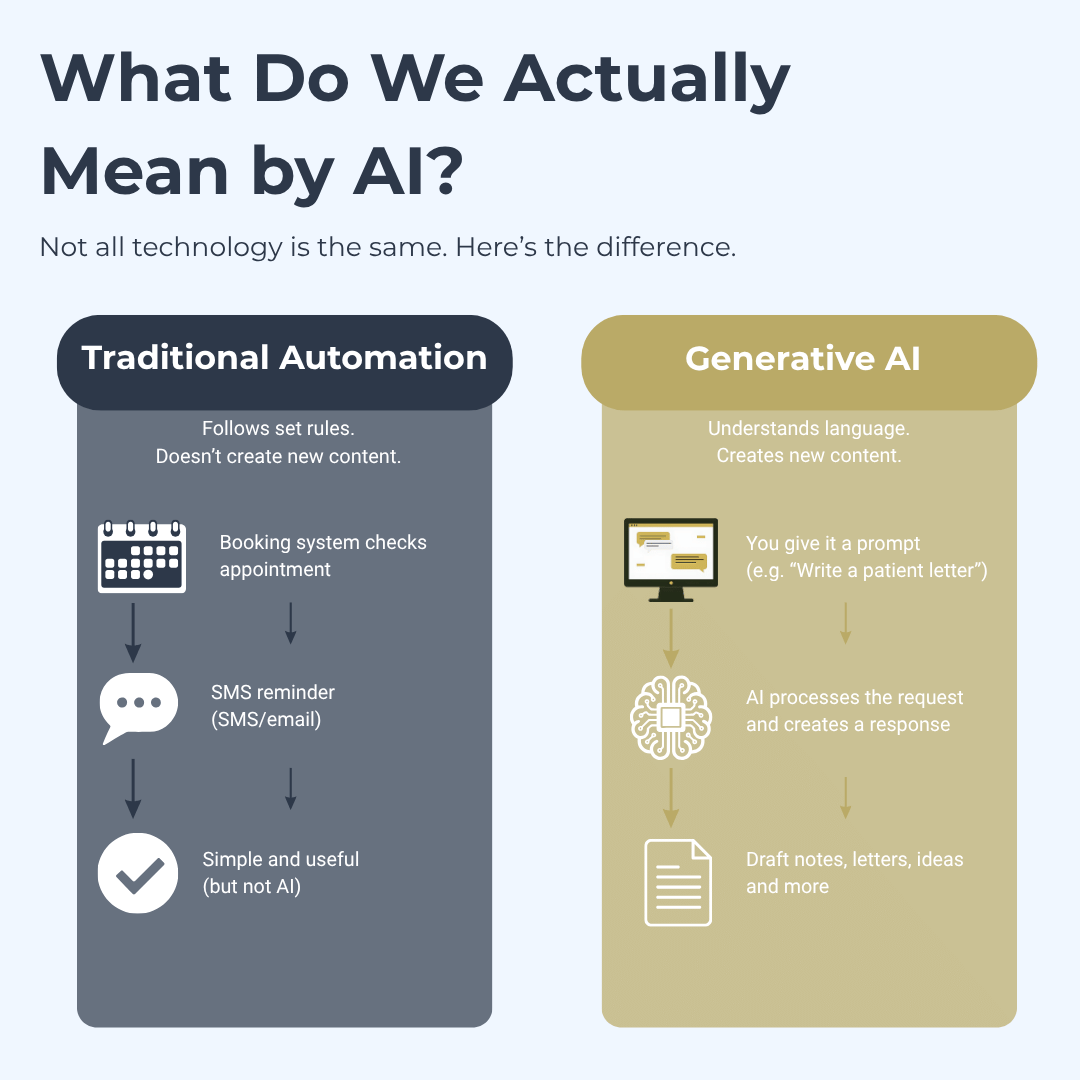
“AI” has become a marketing sticker, so it helps to be precise. Your booking system sending a reminder 48 hours before an appointment is not AI. It is a simple rule: if appointment is in two days, then send text. Useful, but it has been around for twenty years.
The AI worth talking about today is mostly generative AI — systems trained on vast amounts of text, speech and images that can understand plain language and produce something new. It can listen to a consultation and write the notes. It can read a messy spreadsheet and explain it. It can draft a patient letter in your tone. It is not following a script someone wrote in advance; it is working out a response each time.
That is also why it needs checking. Traditional software is predictable but rigid. Generative AI is flexible but can be confidently wrong. The rule of thumb: let it draft, never let it decide.
The opportunities: more time on feet, less on paperwork
Most independent practices run lean. The owner is often the lead clinician, the marketer, the HR department and the bookkeeper. AI can take real weight off every one of those roles.
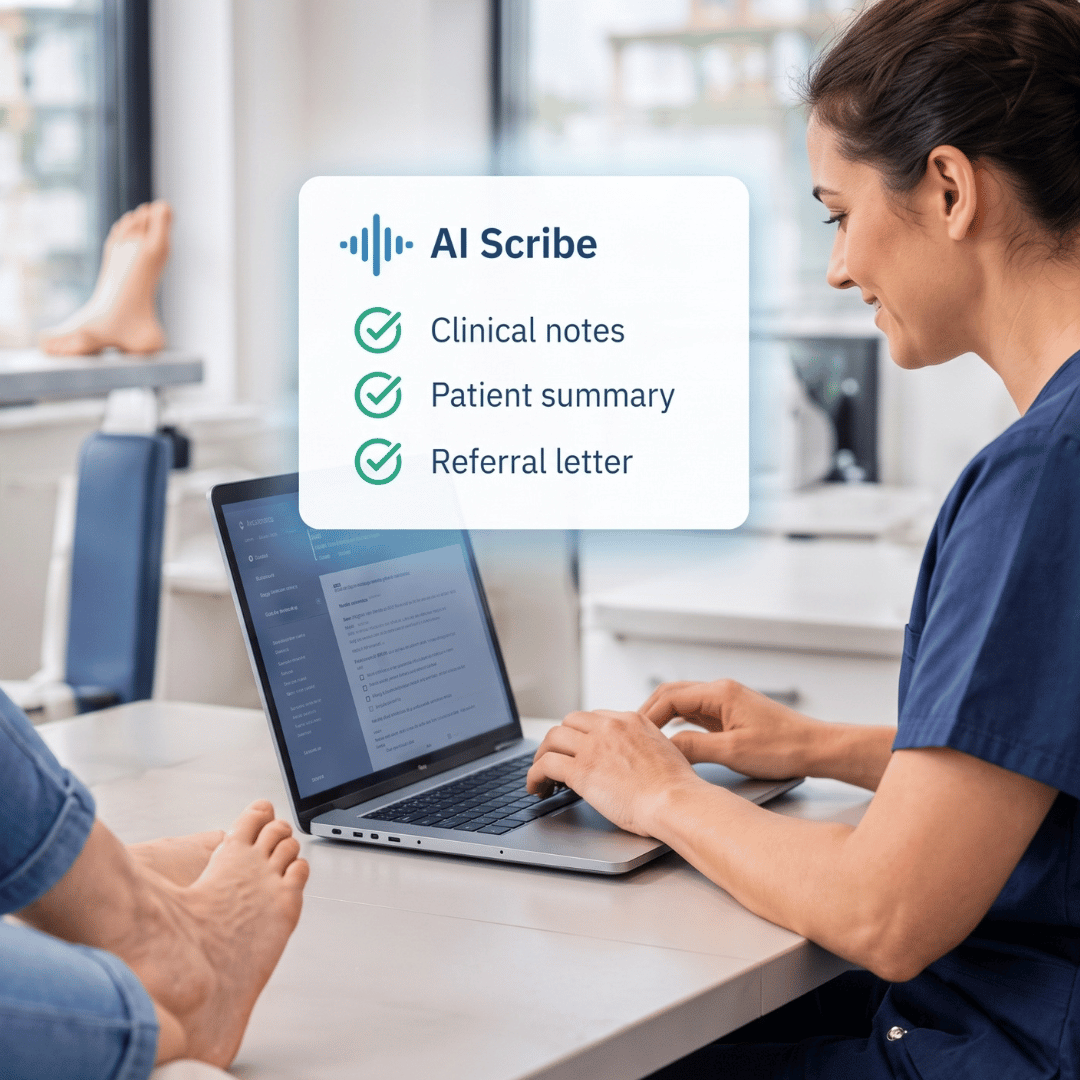
Clinical notes in a fraction of the time. AI scribe tools can listen to a consultation (with the patient’s consent) and draft structured notes for the clinician to check and sign. Several podiatry systems now build this in (see below). Record-keeping stays your responsibility under HCPC standards, but the typing largely disappears. For many podiatrists, that means finishing on time rather than writing up at the kitchen table.
Fewer empty chairs. Smarter booking systems can send tailored reminders, fill late cancellations from a waiting list and flag patients overdue for routine care. Every missed appointment recovered goes straight to the bottom line.
Marketing that finally gets done. Patient leaflets, website pages on plantar fasciitis or verrucae, Google Business updates, recall letters — AI can draft them in minutes. The best results come when you feed in your own clinical knowledge and local detail, then edit in your voice.
Sharper assessment. Gait analysis software, 3D foot scanning for orthotics and image-based tools for wound tracking are all improving fast. Used well, they make assessments more consistent and give patients something visual they understand — which helps them say yes to a treatment plan.
Meeting growing demand. An ageing population, rising diabetes numbers and long NHS waits are pushing more patients towards private care. AI helps a small team see more of them without the owner burning out or rushing a new hire.
What your practice software can already do
The biggest AI win for most podiatry practices is the AI scribe: it listens to the consultation (with consent), then drafts structured notes, referral letters and patient summaries for you to check and sign. Several systems popular with UK podiatrists now offer this, either built in or via a connected app.
| System | AI on offer | How it works |
| Jane | AI Scribe, built in | £15 per practitioner per month, with five free notes a month to try it. UK data is stored in London, is not used to train AI, and the scribe is registered with the MHRA as a Class I medical device. Now works on video appointments too. |
| WriteUpp | AI Medical Scribe, built in (2026) | Per-user add-on. Records the consultation or takes dictation afterwards, and drafts notes in standard formats straight into the patient file. Can also fill in assessment forms. |
| Semble | AI notes via Heidi Health | Heidi pulls in the day’s appointments, drafts notes from the conversation and pushes them back into the Semble record in one click. |
| Cliniko | No built-in scribe, but a marketplace of AI apps | Options include Heidi, Clindoc (UK-built, saves draft notes into Cliniko for approval) and Clinic Notes AI, created by podiatrists in Donegal. AI phone receptionists such as Aeva and BookedSolid can also answer calls and book appointments 24/7. |
| Standalone scribes | Heidi, Tandem, PatientNotes | Work alongside any system. Some offer podiatry-specific templates, but without a direct link you may be copying and pasting notes across. |
The practical difference between these options is integration. A scribe that writes straight into your patient record saves real time. One that makes you copy and paste saves far less, and adds a data-handling risk.
Whichever you choose, ask three questions before signing up. Where is the data stored? Is it used to train the AI? And is the tool registered with the MHRA as a medical device?
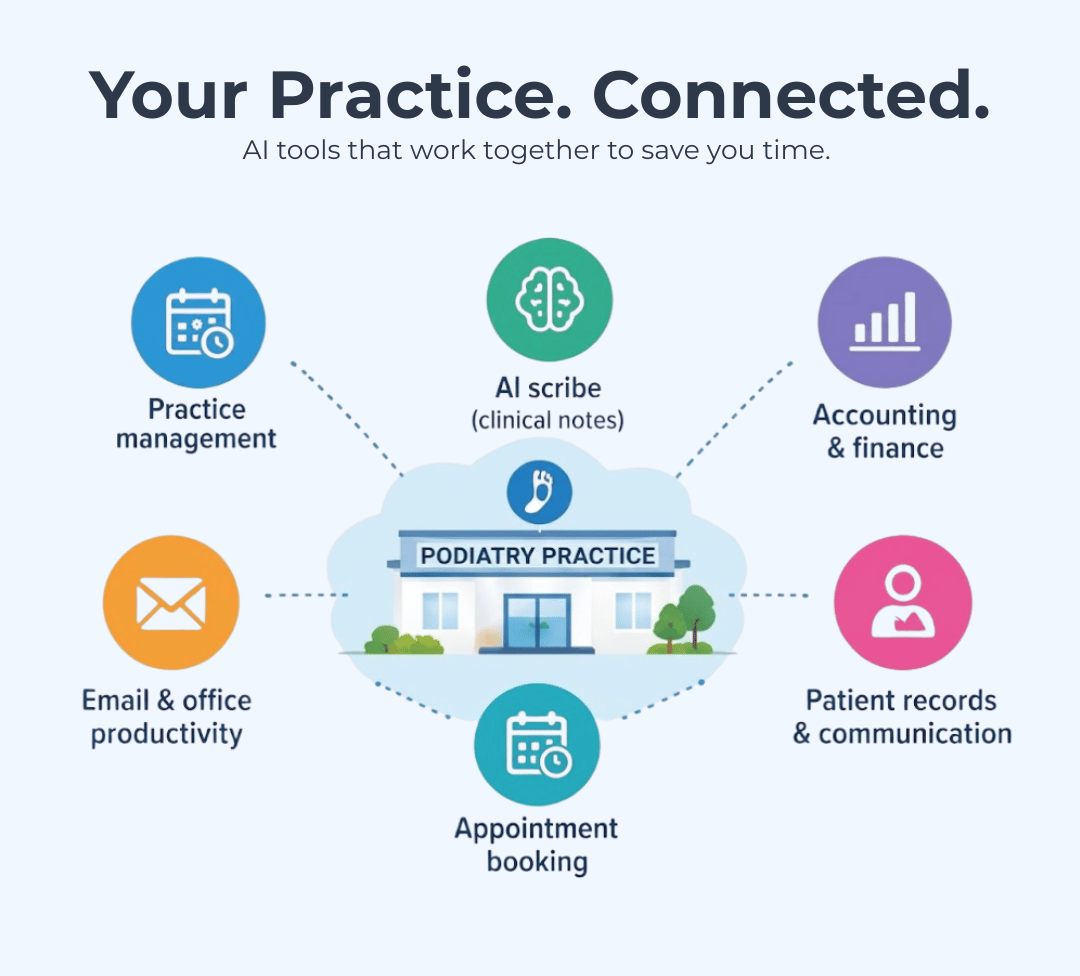
The AI already in your office and accounts software
You may already be paying for AI without realising it. The big office and accounting platforms have all built it in over the past two years.
| Tool | What the AI does | Useful in a practice for |
| Google Workspace with Gemini | Included in business plans since January 2025. Business Starter gets Gemini in Gmail only. Business Standard adds Docs, Sheets, Slides and automatic meeting notes in Meet. | Drafting and summarising emails, writing patient leaflets, analysing a spreadsheet of appointments. |
| Microsoft 365 Copilot Business | A paid add-on for firms under 300 users, from around £16 per user per month on top of your Microsoft 365 plan. Works inside Word, Excel, Outlook and Teams, using your own files and emails. | Summarising Teams meetings, drafting policies and job adverts, pulling figures out of Excel in plain English. |
| Xero JAX | Xero’s AI assistant. It can chase overdue invoices and switch tactics if a customer ignores the first reminder. It flags bills with unusual amounts, changed bank details or unknown suppliers, and suggests ways to ease short-term cash pressure. | Cash flow, bank reconciliation and spotting invoice fraud before you pay. |
| Sage Copilot | Built into Sage Accounting since March 2025, and now in Sage 50. Keeps watch on your figures and flags tax issues, profitability, overdue payments and errors. | Month-end checks, overdue payments and plain-English questions about your numbers. |
The changed-bank-details check in Xero deserves a special mention. Fake supplier invoices are one of the commonest frauds against small practices, and this is AI working as a second pair of eyes.
Then there are the general assistants — ChatGPT, Claude, Gemini and Copilot. These are excellent for marketing copy, blog posts on common foot conditions, staff handbooks and thinking through a business decision. The one firm rule: never put identifiable patient information into a free or personal account. For anything clinical, use a tool built for healthcare.
The threats: quieter than the headlines
The risks are real, but they are not robots taking over the clinic. They are subtler.
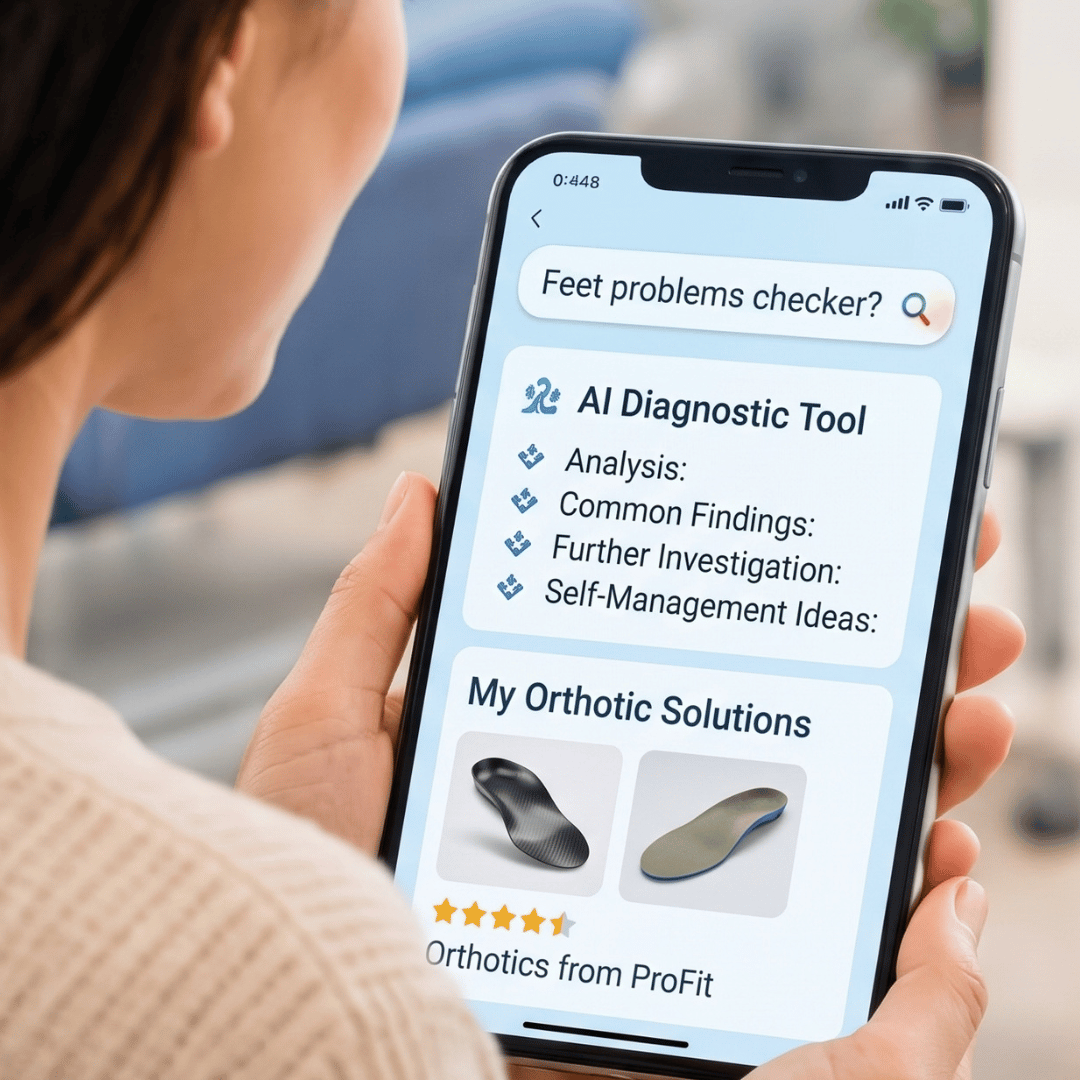
Patients who self-diagnose. More people now describe their heel pain to an AI assistant before they ring anyone. Some will get sensible advice and come in sooner. Others will buy a £20 insole online and never book. Practices that rely on simple, one-off problems are the most exposed.
Direct-to-consumer orthotics. Phone-based foot scanning and online custom insoles are getting better and cheaper. If orthotics are a big slice of your income, expect price pressure. Your defence is clinical assessment and follow-up — which an app cannot provide.
Faster competitors. Growing podiatry groups and multi-site clinics are investing in AI booking, marketing and reporting. An independent that falls well behind risks losing patients on convenience alone, not on quality of care.
Data and professional risk. Patient records are special category data under UK GDPR. Staff pasting notes into free chatbots is a genuine breach risk. AI-drafted clinical content can be confidently wrong, and the HCPC will hold the registrant accountable, not the software. Phishing emails and fake supplier invoices are also getting far more convincing.
Being found: the quiet shift in how patients choose you
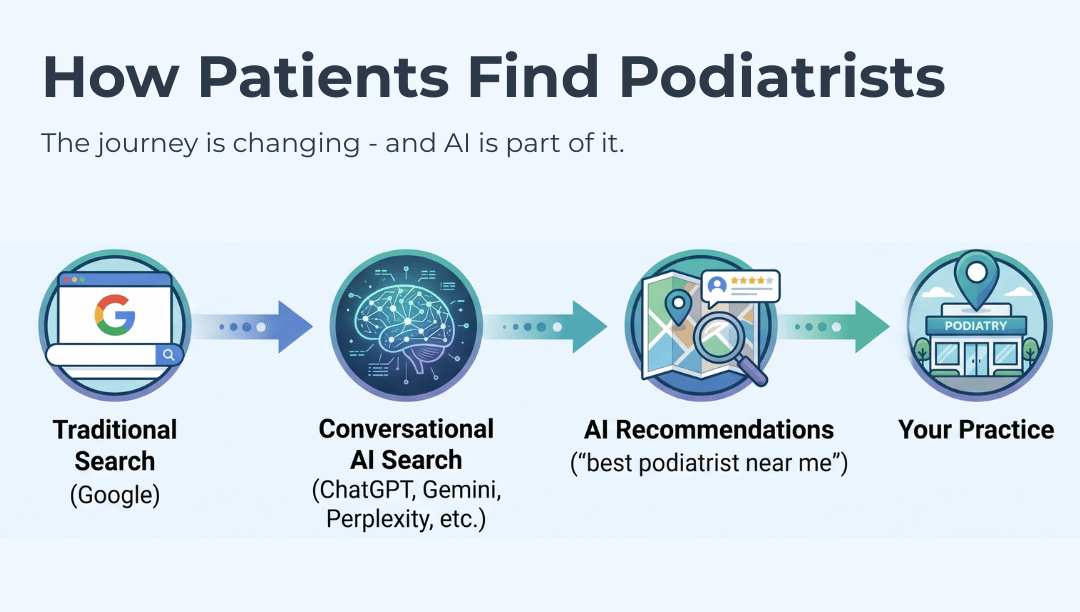
For twenty years the rule was simple: rank on page one of Google and the phone rings. That rule is breaking. Google is still the main way people look for a podiatrist, but more and more of them now get their answer from AI — either Google’s own AI summary at the top of the page, or a chatbot like ChatGPT — without ever clicking through to a website.
| The shift | The number | Source |
| UK adults using AI tools such as ChatGPT, Copilot or Gemini | 54%, up from 31% in 2024 | Ofcom, 2026 |
| UK visits to ChatGPT, first eight months of the year | 1.8 billion in 2025, up from 368 million in 2024 | Ofcom Online Nation 2025 |
| Google searches where people click a normal result | 8% when an AI summary appears, versus 15% without one | Pew Research |
| Clicks to the number-one Google result when an AI summary appears | 58% lower than before AI summaries | Ahrefs, Dec 2025 data |
| US Google searches ending with no click at all | 68% in early 2026 | SparkToro |
| Consumers who used AI to find a local business in the past year | 45%, up from 6% a year earlier | BrightLocal, 2026 |
Some of these figures are from the US, where the trend tends to run a year or so ahead of the UK. The direction of travel is the same here.
What this means for a podiatry practice
The hardest hit will be “information” searches — what causes heel pain, how to treat a verruca. Google’s AI now answers those directly, so the blog posts many practices wrote to attract visitors will bring in less traffic.
“Choosing” searches — podiatrist near me, best podiatrist in Solihull for ingrown toenails — still lead to a decision. But the shortlist is increasingly drawn up by AI rather than by the patient scrolling through links. If the AI doesn’t mention you, you may never be considered.
There is some reassurance. People aged 30–44 are the heaviest users, with 64% asking AI for a business recommendation last year, against 24% of over-60s (BrightLocal). Many podiatry patients are older, so the change may reach you a little more slowly. But their adult children often do the research for them. And nearly all AI users (97%) still check the recommendation against real reviews before acting on it.
Is it worth investing in? Yes — and it needn’t cost much
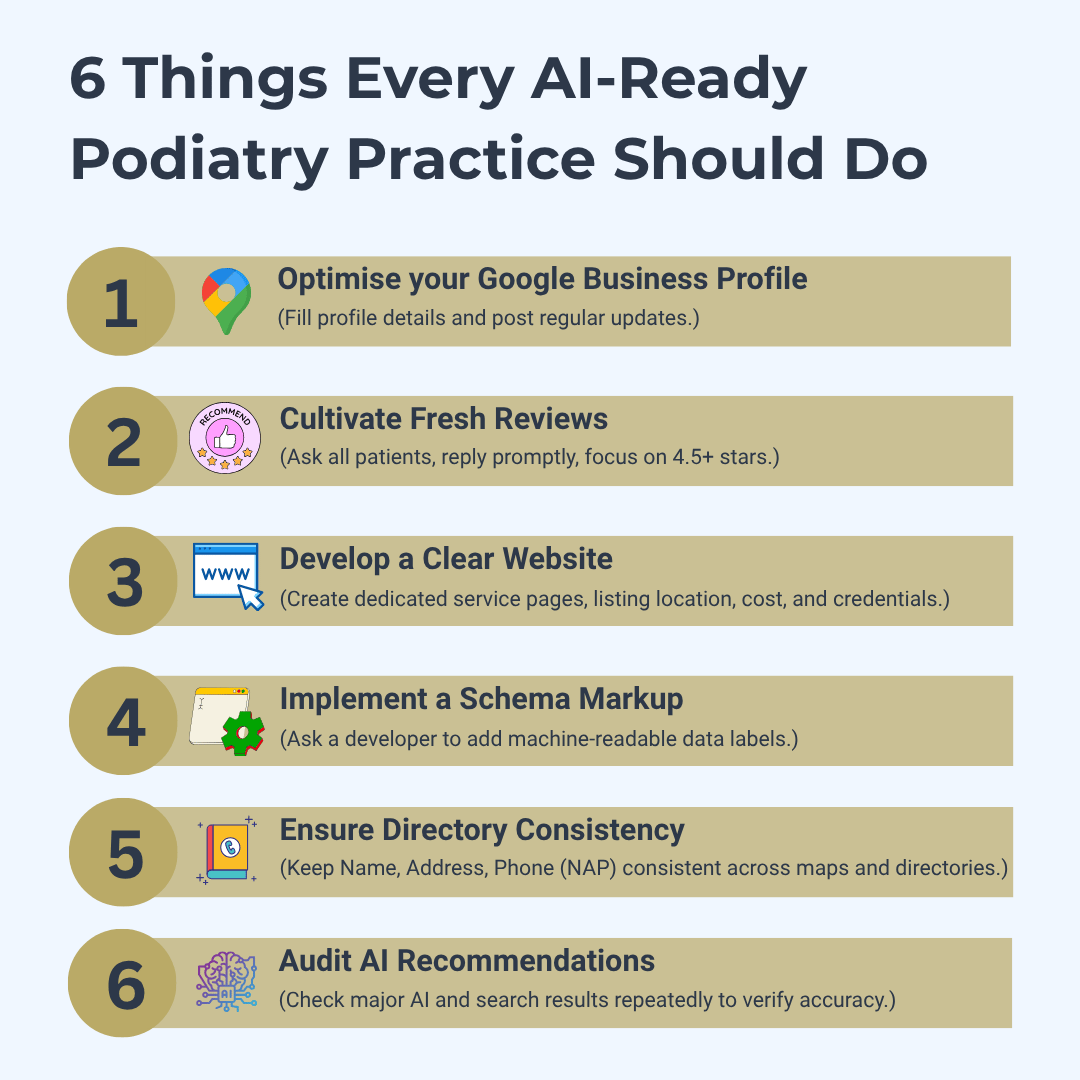
AI tools recommend businesses they can clearly understand and trust. Most of what helps is simply good housekeeping that many practices have let slip:
- Google Business Profile. Complete every field: services, hours, photos, accessibility and booking link. Post updates now and then. This feeds Google’s AI directly.
- Reviews. Ask every happy patient, and reply to every review. Fresh reviews of 4.5 stars or more now matter more than ever, to people and to AI.
- A clear, factual website. One page per service and condition. State plainly where you are, who you treat, what it costs, and that your clinicians are HCPC-registered. Add short answers to the questions patients actually ask. AI rewards clarity and punishes vagueness.
- Behind-the-scenes setup. Ask your web developer to add “structured data” (schema markup). This labels your address, services and opening hours so machines can read them without guessing. It is usually a small one-off job.
- Be consistent everywhere. Your name, address and phone number should match across Google, Bing, Apple Maps, the Royal College of Podiatry’s Find a Podiatrist and any other directories. Conflicting details make AI less confident about recommending you.
- Check what AI says about you. Ask ChatGPT, Gemini and Google’s AI Mode to recommend a podiatrist in your town. Are you mentioned? Is what it says accurate? Repeat every few months.
For most practices, this is a day or two of owner time plus a modest spend with a web developer. Set that against the cost of a steadily emptier diary. And there’s an upside: studies suggest businesses cited inside Google’s AI answers get noticeably more clicks than those that aren’t (Seer Interactive).
What it means for the value of your practice
If you plan to sell, bring in a partner or step back one day, AI matters for one reason: what it does to the things buyers already pay for.
Those fundamentals haven’t changed. Buyers want sustainable profit, a loyal and growing patient base, and a practice that doesn’t depend on the owner being in the chair every day. Used well, AI can strengthen each of these: lower admin costs, fewer missed appointments, cleaner records, a stronger online presence, and systems a new owner can pick up and run.
It is too early to say that using AI earns a premium in its own right. “AI-ready” is not a line in a podiatry practice valuation. What a buyer will see is the result — healthier margins, a fuller diary, and a business that runs without you at the centre of everything.
The practices that hold their value best combine two things. Out front: trusted clinicians, loyal patients and hands-on care that no algorithm can deliver. Underneath: efficient systems that make the whole operation less dependent on any one person.
Where to start
You do not need a grand AI strategy. You need a few sensible moves.
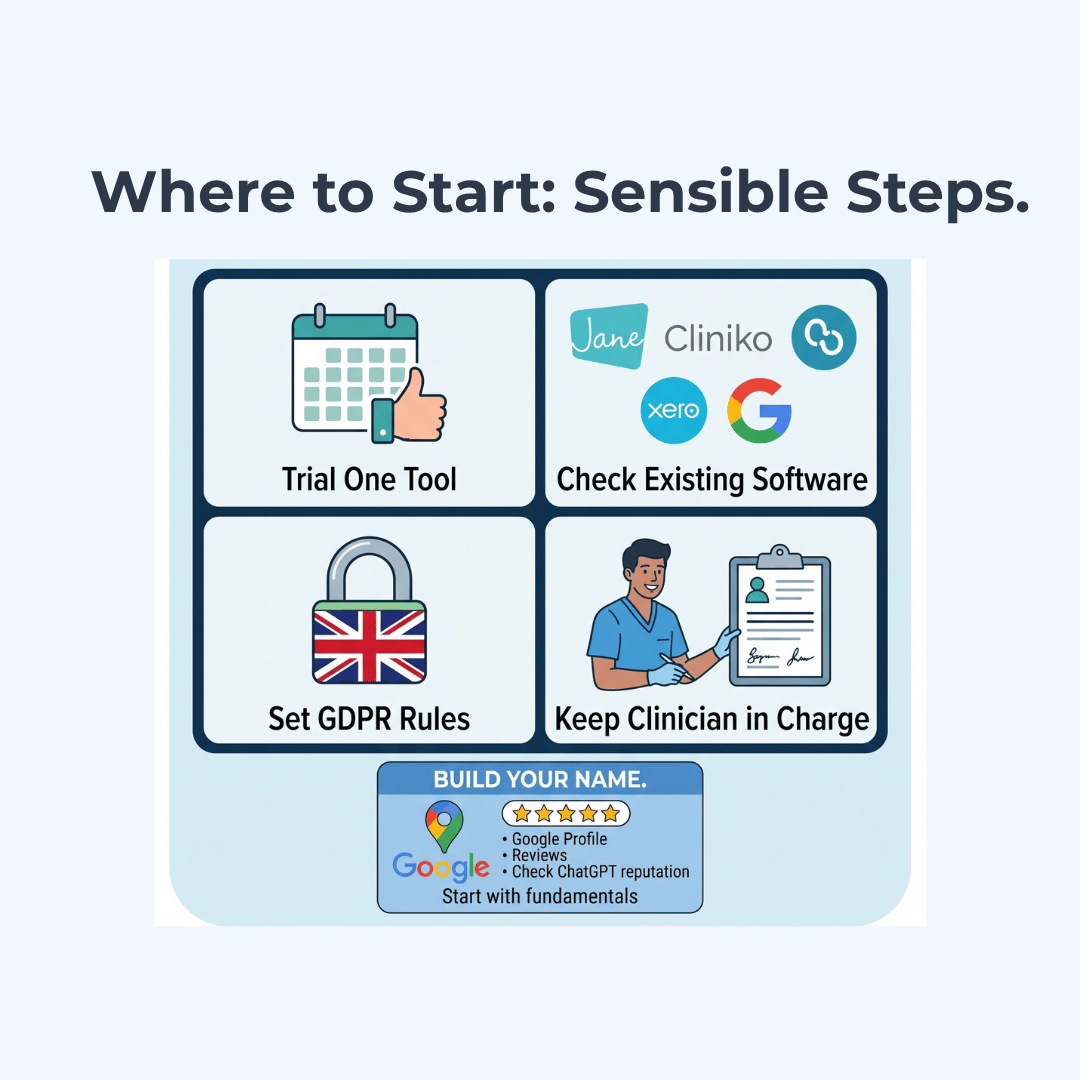
- Pick one pain point. Notes, no-shows or marketing — whichever costs you most time. Trial one tool for a month and measure the difference.
- Check your practice software first. Jane, WriteUpp and Semble already offer AI scribes, Cliniko connects to several, and Xero, Sage, Google and Microsoft all have AI built in. Using what you already pay for is simpler and safer.
- Set a data rule. No patient details go into any tool unless it meets UK GDPR requirements and you have checked where the data is stored. Tell every member of staff.
- Keep the clinician in charge. AI drafts; a registered podiatrist checks and signs. Always.
- Build your name. The more patients ask for your practice by name, the less a chatbot or online insole can take from you. Start with your Google Business Profile, your reviews and a quick check of what ChatGPT says about you.
The bottom line
AI won’t replace a good podiatry practice — but a practice that ignores it may slowly lose ground to one that doesn’t. The patients still need skilled hands. What’s changing is how they find you, how quickly you respond and how efficiently the practice runs behind the scenes. Treat AI as a capable assistant: let it take the admin, the reminders and the first drafts, so you and your team can focus on the care patients actually come for.
None of this needs a big budget or a technology overhaul. A few sensible steps now will keep your practice visible, efficient and valuable — whatever you plan to do with it next.
Thinking about the future of your practice? Podiatry Business Central helps podiatry practice owners build more profitable, more valuable businesses — and plan the right exit when the time comes. Visit podiatrybusinesscentral.co.uk for more practical insight, or get in touch for a confidential conversation about where your practice stands today and where you’d like it to go.